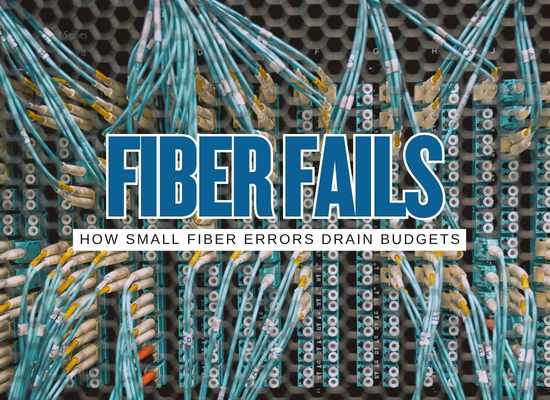
Fiber optics should be a future-proof investment—but for many businesses, it turns into a costly headache. Whether you’re expanding your data backbone, upgrading a facility, or deploying new infrastructure, small missteps in your fiber optic setup can snowball into serious downtime, massive rework costs, or lost contracts. Here’s a breakdown of the most expensive mistakes companies make—and how to steer clear of them.
1️⃣ Buying the Wrong Cable Type for the Application
Problem:
Many buyers don’t understand the difference between single-mode and multi-mode fiber. Choosing the wrong type can lead to poor performance, compatibility issues, or even needing to rip out and replace cabling entirely.
Real-World Cost:
Replacing a 5,000-foot run of incorrectly spec’d fiber can cost upwards of $25,000, including labor and materials.
Solution:
Always consult the equipment specs before purchase. For long-distance data transmission (over 300 meters), go with single-mode. For shorter distances and LAN setups, multi-mode (OM3 or OM4) is typically ideal. When in doubt, verify with both your installer and equipment manufacturer.
2️⃣ Poor Splicing or Termination Work
Problem:
Cutting corners during fusion splicing or connector termination leads to high insertion loss or reflection, which drastically reduces signal quality and reliability.
Real-World Cost:
Faulty terminations can cost $100–$500 per splice to re-do, not including the potential network outage it causes.
Solution:
Use certified technicians with calibrated equipment. For mission-critical projects, request OTDR (Optical Time Domain Reflectometer) test results as proof of splice quality.
3️⃣ Skipping Environmental Considerations
Problem:
Fiber optics are sensitive to their environment. Failing to account for temperature, moisture, rodents, UV exposure, or vibration can destroy your cable investment faster than you think.
Real-World Cost:
Moisture intrusion into improperly sealed outdoor cabling can lead to a full system failure, requiring trenching and replacement—often costing $10,000+.
Solution:
Choose armored fiber for areas with high risk of physical damage, gel-filled or water-blocked cables for wet environments, and use UV-rated jackets for outdoor exposure. Don’t forget inner ducting for additional protection.
4️⃣ Overlooking Bend Radius Specifications
Problem:
Fiber optic cables are not as forgiving as copper. Exceeding the minimum bend radius—especially during installation around corners or in tight enclosures—can cause micro-fractures and permanent signal loss.
Real-World Cost:
A single overstressed bend can degrade signal quality across an entire segment, often requiring full cable replacement—a $5,000–$15,000 mistake depending on length and location.
Solution:
Always follow manufacturer bend radius guidelines (usually 10x the cable diameter). Use fiber management trays and radius-controlled guides for tight spaces. Train installers to spot and correct tight loops or pinches during deployment.
5️⃣ Not Testing After Installation
Problem:
Skipping post-installation testing is like building a bridge without inspecting the supports. Many issues—attenuation, breaks, poor splicing—go unnoticed until the network fails during real-world use.
Real-World Cost:
Troubleshooting live fiber networks is far more expensive and disruptive. Identifying and fixing a failure post-deployment can cost 5–10x more than catching it during install.
Solution:
Mandate comprehensive testing: power meter and light source for loss testing, and OTDR for end-to-end quality and break detection. Keep test documentation for accountability and future diagnostics.
6️⃣ Improper Cable Labeling and Documentation
Problem:
When fiber runs aren’t properly labeled, future maintenance becomes a nightmare. Techs can waste hours identifying which cable leads where—especially in multi-floor or multi-building deployments.
Real-World Cost:
Troubleshooting misidentified fiber links in enterprise environments can rack up thousands in labor costs and lead to unnecessary service disruptions.
Solution:
Label both ends of every run with clear, durable ID tags. Maintain a digital cable map with pathways, termination points, and fiber counts. If multiple contractors are involved, standardize labeling protocols across the board.
7️⃣ Using Incompatible Connectors or Adapters
Problem:
Mixing connector types (like LC, SC, ST) or failing to match polish types (UPC vs. APC) can lead to signal degradation, reflection issues, or physical damage to sensitive ports.
Real-World Cost:
Replacing damaged patch panels, ports, or connectors can easily exceed $1,000–$3,000, not including labor and network downtime.
Solution:
Standardize your connector types and polish formats before you begin. Double-check compatibility between devices, and use clean, precision-fit adapters if absolutely necessary. Avoid mixing UPC and APC at all costs.
8️⃣ Ignoring Future Capacity Planning
Problem:
Installing just enough strands for today’s need is short-sighted. Adding new fiber later means repeating trenching, permitting, and downtime—often at a much higher cost.
Real-World Cost:
Digging up a route to lay additional fiber can cost $15,000–$50,000, depending on terrain, permits, and distance.
Solution:
Deploy extra dark fiber during your initial install. Even just 4–12 extra strands can provide critical flexibility as your bandwidth needs scale.
9️⃣ Dirty Connectors and Endfaces
Problem:
Even tiny specks of dust or oil can block or scatter light, degrading performance. Many installations suffer because connectors weren’t properly cleaned before being plugged in.
Real-World Cost:
Network performance issues caused by dirty connectors can lead to costly service calls, signal loss, and hardware damage—sometimes exceeding $1,000 per event.
Solution:
Use proper fiber cleaning kits—not tissues or compressed air. Every connector should be cleaned and inspected with a scope before insertion. Train your techs and hold them accountable.
🔟 Hiring Low-Cost or Inexperienced Contractors
Problem:
Fiber optic installation is highly technical. Inexperienced contractors may make any of the above mistakes—or worse—leaving you with a network that underperforms from day one.
Real-World Cost:
Rework from poor installation often exceeds $10,000–$100,000, depending on scale, plus legal headaches if warranties aren’t honored.
Solution:
Vet your contractors. Ask for certifications, references, and OTDR test results on previous jobs. Don’t be swayed by the lowest quote—it often comes with the highest risk.
🔚 Avoid the “Cheap Fiber” Trap
Fiber optics are one of the best investments your business can make—but only when done right. What seems like a “small oversight” today can snowball into major costs tomorrow. Take the time to plan, hire quality professionals, and think long-term. In fiber optics, doing it right the first time is always cheaper than doing it twice.