
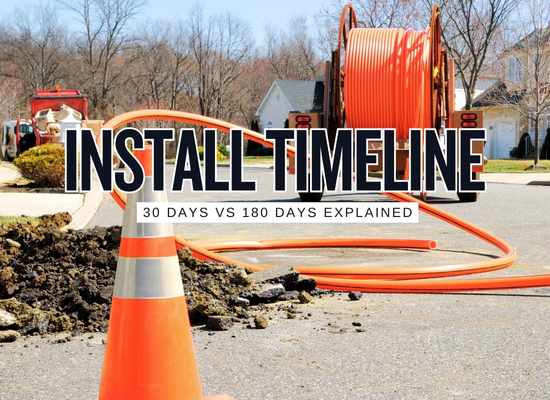
A fiber install moves fast when the location is already lit, the building pathway is straightforward, and there is no outside plant work or pole make ready. Timelines stretch when the order turns into construction, permitting coordination, or pole attachment work with regulated process steps and longer make ready windows.
The timeline is mostly decided before the first crew rolls
Fiber orders finish quickly when you are truly on-net and the building path is ready. They take months when the order quietly becomes a civil,
permitting, or make-ready project.
The 6 stages most installs pass through
- Order intake and validation including serviceability check and address confirmation
- Site survey building entry, demarc location, pathway, power, and any special constraints
- Engineering route plan, materials, splicing plan, and construction method if needed
- Permits and coordination ROW approvals, traffic control, building access approvals
- Build and place pull, bore, trench, aerial lash, or pole attachment work as required
- Splice test light up splicing, OTDR testing, handoff, and activation
The 30 day path
This is the fast lane. It happens when the provider already has usable fiber close to the building, the building has a clean pathway,
and the job is mostly inside work plus a short final segment.
A realistic 30 day sequence
Days 1 to 5
Address validation, serviceability check, building contact confirmed, demarc location agreed, site survey scheduled.
Days 6 to 12
Site survey completed, inside pathway confirmed, materials staged, short external work approved if needed.
Days 13 to 24
Cable pulled, demarc installed, splicing scheduled, building access windows coordinated.
Days 25 to 30
Splice and test, service activation, handoff to customer edge, acceptance test.
Fast lane triggers
On-net building or very short last mile work, straightforward building entry, no special permits, and no pole make ready.
The 180 day path
This is the long lane. It happens when outside plant work is required, permitting and coordination expand, or the build depends on pole attachment
make ready timelines or construction windows.
A realistic 180 day sequence
Weeks 1 to 3
Order validation, survey, engineering begins. The provider confirms whether the site is on-net, near-net, or requires a new span.
Weeks 4 to 8
Permitting workflow starts. Building access rules, ROW approvals, traffic control assumptions, and any special crossings are addressed.
Weeks 9 to 18
Construction window. Trench or bore work, conduit placement, restoration, or aerial work. If poles are involved,
make ready steps can be a major calendar driver.
Weeks 19 to 26
Splicing and testing across the new segment, final drop into the building, activation, and acceptance testing.
Long lane triggers
New outside plant segment required, significant permitting and restoration constraints, make ready needed on congested poles,
or building pathway work that behaves like construction.
Timeline reality table
The four delay buckets that add months
1️⃣ Permitting and ROW conditions
Fees are usually not the problem. Conditions are. Traffic control, restricted work hours, restoration specs, and inspection timing
can turn a simple route into a long schedule.
2️⃣ Make ready and pole attachment sequencing
When poles are involved, the schedule can be governed by survey, estimate, payment, and make ready phases.
For some categories of work, published timelines include make ready windows that can extend to 120 days for communications space
and 180 days for work involving power space timelines.
3️⃣ Unknown utilities and civil surprises
Rock, groundwater, unmapped utilities, and required route changes force redesign and new approvals. These events are normal enough that
the best teams budget and schedule for them instead of treating them as rare.
4️⃣ Building readiness and access failures
Locked MPOE rooms, unclear demarc location, no power or grounding, and unclear riser pathways can stall a project even when street fiber is available.
In multi tenant buildings, this can be the hidden reason a “simple order” stretches.
Interactive timeline estimator
This planner estimates a schedule band by combining the most common drivers. It is not a provider commitment.
It helps teams ask better questions before they promise an install date internally.
Results
Estimated calendar days
0
Schedule band
–
Likely blockers to watch
–
Owner playbook that speeds installs without drama
The fastest teams remove ambiguity early
The goal is to avoid mid-project rework. These items prevent the most common stalls.
- Assign one building contact who can grant access to telecom rooms and approve work windows
- Pre-pick the demarc location with power and grounding confirmed
- Verify inside pathway from entry point to tenant space so the order does not become a surprise build
- Ask for the serviceability class on-net vs near-net vs build required
- Request written assumptions for permits traffic control and restoration when any street work is expected
- Schedule an acceptance test so activation is not delayed by handoff confusion

