
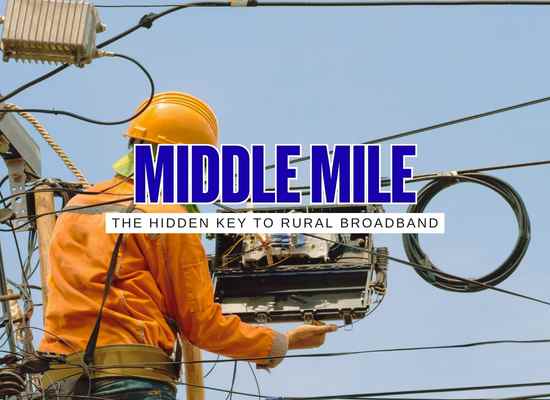
Rural broadband projects often rise or fall before the first home is connected. The decisive layer is frequently the middle mile, the high-capacity fiber route that connects local last-mile networks to regional internet exchanges, carrier hotels, cloud routes, schools, hospitals, public safety sites, and larger backbone networks. NTIA’s Enabling Middle Mile program allocated about $980 million for projects across more than 370 counties in 40 states and Puerto Rico, while BEAD implementation is now moving into the construction and subaward phase in many places. That timing matters because rising fiber deployment costs, permitting delays, labor limits, and make-ready work can turn a promising last-mile project into a fragile business plan if the middle-mile route is too far away, too expensive, too slow, or controlled by too few options.
Last-mile broadband gets the public attention because it reaches homes and businesses. Middle-mile fiber often decides whether that last-mile network can deliver strong performance, affordable service, workable operating costs, and long-term upgrade capacity.
Rural broadband projects are usually judged by the final connection: the fiber drop to the home, the fixed wireless subscriber link, the monthly plan, the speed tier, or the number of unserved locations reached. That focus is understandable, but it can hide the layer that determines whether the local network has a sustainable future. Middle-mile fiber is the transport layer between the local access network and the broader internet ecosystem. It does not usually connect directly to the customer, but it shapes cost, capacity, latency, reliability, competition, and expansion.
In a dense city, the middle-mile problem may be hidden because multiple carriers, internet exchanges, data centers, and fiber routes are nearby. In rural areas, that same connection may require long distance transport, difficult rights-of-way, limited carrier choice, high monthly backhaul costs, and expensive route redundancy. A last-mile project can look strong on a grant map and still become difficult to operate if the middle-mile connection is weak.
Central idea for rural broadband planning
Middle-mile fiber is not a side project. It is the cost and capacity bridge between rural last-mile promises and real-world service quality. If the bridge is too expensive, too far away, too congested, or too fragile, the last-mile network inherits those problems for years.
The hidden layer between the home and the internet backbone
A local broadband network needs more than a connection to each home. It needs a way to move all customer traffic out of the local area and into larger internet routes. That is the middle mile. It can connect rural providers to regional data centers, internet exchange points, carrier networks, cloud routes, public institutions, and wholesale bandwidth providers.
Without strong middle-mile access, a provider may build fiber past hundreds or thousands of rural locations, but still struggle with high upstream costs, limited redundancy, performance bottlenecks, or weak upgrade economics. The last mile may be the visible part of the project. The middle mile is often the part that determines whether the network can survive normal customer growth.
Fiber-to-the-home, fixed wireless, hybrid fiber, or other last-mile systems that connect homes, farms, schools, clinics, and businesses.
High-capacity transport fiber that carries local traffic to larger networks, exchanges, carrier points, and cloud-connected routes.
The broader network environment where traffic reaches content platforms, cloud services, enterprise systems, public services, and national or global routes.
Recent funding and policy signals
The current rural broadband cycle is different from earlier cycles because federal and state funding is moving at the same time as cost pressure, labor limits, and technology debates. BEAD is pushing states and providers toward implementation. NTIA’s middle-mile program is aimed at expanding and extending middle-mile infrastructure. States such as California are also building open-access middle-mile networks designed to help providers reach unserved and underserved communities.
| Signal | Recent development | Project-level meaning | Source |
|---|---|---|---|
| Federal funding | NTIA’s Middle Mile Grant Program allocated about $980 million for middle-mile infrastructure across more than 370 counties in 40 states and Puerto Rico. | Middle-mile capacity is being treated as a national broadband deployment issue, not only a local carrier concern. | NTIA Middle Mile Program |
| BEAD execution | NTIA’s BEAD dashboard tracks eligible entity progress through major program milestones as states and territories move toward universal broadband access. | Last-mile construction plans are entering a period where middle-mile availability can affect actual build feasibility. | NTIA BEAD Dashboard |
| Cost pressure | The Fiber Broadband Association reported that 88% of survey respondents expected fiber deployment costs to rise again in 2026, driven by labor and materials, with permitting and make-ready also cited. | Every avoidable mile, delayed pole attachment, or unnecessary duplicate route can weaken broadband project economics. | Fiber Broadband Association |
| Open-access model | California is building an open-access statewide middle-mile network so providers and eligible entities can connect and deliver service to underserved areas. | Open-access middle mile can lower entry barriers for last-mile providers when pricing, route access, and operations are workable. | California CPUC |
| Planning framework | The Fiber Broadband Association’s Middle Mile Working Group released a 2026 framework encouraging fiber-first planning, cross-agency coordination, and statewide infrastructure inventories. | Statewide planning can reduce duplicate construction and identify existing fiber assets before new last-mile grants are finalized. | FBA Middle Mile Framework |
🟦 1. Middle-mile distance can change the last-mile business case
The farther a rural provider sits from affordable middle-mile capacity, the harder the economics become. A last-mile network may have grant support for customer connections, but still need recurring transport capacity, network electronics, maintenance, power, hut space, route redundancy, and upgrade planning. If the provider must lease expensive transport over a long distance, the monthly operating cost can reduce margins immediately.
This can become a quiet affordability problem. A provider may be able to build the network with grant support, but the ongoing cost of reaching the internet backbone can push retail prices higher, limit speed upgrades, or make business service less competitive. In extreme cases, weak middle-mile economics can discourage providers from bidding on difficult rural areas at all.
Planning lens
A rural project should not only ask whether homes can be passed. It should ask whether the network has affordable, scalable, and redundant transport to the broader internet for the next decade.
🟦 2. Middle-mile competition can lower risk for rural providers
Rural markets often have fewer transport options than urban markets. If one carrier controls the practical path to a regional hub, the last-mile provider may face limited pricing leverage. Open-access middle-mile networks, carrier-neutral routes, electric cooperative fiber, public utility district fiber, and regional transport partnerships can change that equation.
More options can improve negotiating power and reduce single-provider dependency. Competition can also help smaller ISPs, tribal providers, municipal networks, and cooperatives participate in rural broadband programs without building every mile of transport themselves. The key is not only whether fiber exists nearby. It is whether that fiber is available on terms that support affordable retail service.
🟦 3. Route diversity can separate resilient projects from fragile ones
A rural network with one backhaul path can work well on normal days and still be fragile. Road construction, storms, utility work, fiber cuts, equipment failures, fires, floods, and maintenance windows can affect service across a large geography. For hospitals, public safety, schools, farms, local government, and remote workers, resilience is not a luxury feature.
Middle-mile planning should therefore include route diversity. A network that can reach two physically diverse transport paths is better positioned for reliability than one that depends on a single corridor. In some rural areas, true diversity is difficult or expensive. But identifying that risk early is better than discovering it after the last-mile network is already built.
| Middle-mile condition | Rural project effect | Risk level | Better planning move |
|---|---|---|---|
| Nearby affordable open-access fiber | Lower transport burden, more provider options, stronger upgrade path | Lower | Reserve capacity early and confirm service-level terms before last-mile build commitments. |
| Fiber nearby but controlled by one practical provider | Possible price exposure and limited redundancy | Moderate | Negotiate long-term terms, explore alternate routes, and model future bandwidth growth. |
| Long transport path to the nearest hub | Higher upfront or recurring cost, potential delay, weaker operating margin | High | Evaluate shared middle-mile builds, anchor tenant demand, and state infrastructure coordination. |
| No practical diverse route | Higher outage exposure and less operational flexibility | High | Design backup paths, emergency restoration plans, or phased diversity investment. |
| Existing public fiber assets not inventoried | Potential duplicate construction and missed savings | Moderate | Map schools, utilities, transportation corridors, government fiber, and cooperative assets before final awards. |
🟦 4. Middle-mile fiber can improve grant efficiency
Grant programs are often measured by locations served, but the cost per location is shaped by network architecture. If middle-mile access is closer and more affordable, last-mile providers may be able to serve remote locations with less duplicative transport construction. That can improve the reach of public funding.
This is especially important in areas with difficult terrain, low density, long road miles, seasonal weather limits, or high make-ready costs. In those places, middle-mile coordination can prevent every provider from solving the same transport problem separately. Shared middle-mile routes can create a platform for multiple last-mile networks, enterprise services, public institutions, wireless towers, and future network upgrades.
🟦 5. Anchor institutions can make middle-mile routes more viable
Schools, libraries, hospitals, clinics, county facilities, public safety sites, community colleges, utility facilities, industrial parks, and tribal government offices can help support middle-mile economics. These sites often need better connectivity themselves, and they can provide demand along a route that would otherwise be difficult to justify.
The strongest rural plans often combine residential broadband with institutional and economic development demand. A middle-mile route that supports only a handful of homes may be hard to finance. A route that also supports a school district, a hospital, a sheriff’s office, a water utility, a small manufacturing site, and a wireless tower has a stronger case.
Owner and operator takeaway
The best rural broadband maps should not only show unserved homes. They should also show anchor institutions, existing fiber, utility routes, towers, public rights-of-way, highway corridors, substations, industrial sites, and potential handoff points.
🟦 6. Open access can help, but only if the terms work
Open-access middle-mile networks are attractive because they can allow multiple service providers to use shared infrastructure. In theory, this reduces duplication, expands competition, and helps smaller providers serve communities that would otherwise be difficult to reach. California’s statewide open-access middle-mile initiative is one of the most visible examples of this model.
But open access is not automatically successful. Pricing, connection points, operating support, route availability, service-level commitments, maintenance response, interconnection rules, and upgrade capacity all matter. A route that exists but does not connect at the right place, at the right price, or within the right timeline may not solve the last-mile problem.
🟦 7. Middle-mile planning should happen before final last-mile design
One common mistake is treating the middle mile as a later procurement item. In rural broadband, that can create major redesign pressure. If the middle-mile handoff point changes, the last-mile network design may need different electronics, different hut locations, different power planning, different route engineering, and different redundancy assumptions.
Middle-mile planning should be integrated with the last-mile grant application, engineering study, make-ready review, and operating model. The earlier the middle-mile path is confirmed, the easier it is to estimate realistic capital cost, recurring cost, customer capacity, service pricing, and future upgrade requirements.
Middle-Mile Viability Estimator
This simple planning tool estimates whether a rural last-mile project may face middle-mile pressure. It is not an engineering design model. It helps identify when transport distance, low customer density, high recurring cost, and weak route diversity may need closer review before project awards or construction commitments.
🟦 8. Rising deployment costs make middle-mile coordination more valuable
Fiber construction is not getting easier. Labor, materials, permitting, make-ready, terrain, restoration, and construction method all influence cost. A rural provider may face expensive underground work, aerial make-ready delays, seasonal weather limits, rock, river crossings, rail crossings, highway permits, or long restoration obligations.
When costs are rising, uncoordinated builds become more painful. If a state, utility, county, cooperative, and private provider all plan separately, communities may end up with duplicated routes in some corridors and no practical middle-mile access in others. Strong mapping and coordination can reduce waste and place shared fiber where it supports multiple last-mile projects.
🟦 9. Fiber-first planning does not mean fiber-only thinking
A strong middle-mile strategy can support multiple access technologies. Fiber-to-the-home may be the best long-term option in many places, but fixed wireless, mobile networks, public safety communications, school networks, utility systems, and enterprise service can also benefit from robust middle-mile fiber. The middle mile can act as a shared foundation for multiple community needs.
This is especially important for difficult geographies. In some remote areas, the right solution may combine fiber middle mile, targeted fiber last mile, fixed wireless for lower-density pockets, tower backhaul, and future upgrade paths. A good middle-mile route does not force a single access model. It creates options.
🟦 10. The best middle-mile plans are built around operations
Funding programs naturally emphasize construction, but rural broadband succeeds or fails over the operating life of the network. Monthly transport cost, maintenance, power, electronics replacement, outage response, capacity upgrades, customer support, and wholesale agreements all affect viability. Middle-mile planning needs to include the years after the grant-funded build is finished.
A network that is cheap to build but expensive to operate can create problems later. A network with no upgrade headroom may be adequate at launch and strained within a few years. A network with one route may meet basic requirements but struggle during major outages. Rural broadband planning should measure long-term service quality, not just initial deployment.
| Review area | Strong middle-mile plan | Weak middle-mile plan |
|---|---|---|
| Cost model | Transport cost is modeled per subscriber, per Mbps, and under future growth scenarios. | Backhaul is treated as a generic monthly line item with limited sensitivity testing. |
| Route design | Primary and backup routes are identified, with restoration expectations documented. | The project relies on one practical route with limited outage planning. |
| Interconnection | Handoff points, cross-connects, equipment space, and service terms are confirmed early. | Interconnection assumptions are left unresolved until late procurement. |
| Community assets | Schools, libraries, clinics, utility sites, towers, and public facilities are included in demand mapping. | The route is planned only around residential passings. |
| Upgrade path | Spare capacity, conduit strategy, electronics refresh, and route expansion are considered. | The network is engineered mainly to satisfy launch obligations. |
Near-term outlook for rural broadband builders
The next stage of rural broadband deployment will likely be more operational than promotional. Many communities have maps, funding announcements, and eligibility lists. The harder work is now route engineering, contracting, permitting, make-ready, procurement, construction, testing, and long-term service delivery. Middle-mile fiber will affect all of those phases.
Projects with nearby affordable transport, clear interconnection points, route diversity, and realistic operating costs will have an advantage. Projects that must solve middle-mile access late in the process may face redesigns, higher costs, weaker performance, or reduced provider interest. As BEAD and state programs move further into implementation, middle-mile planning may become one of the clearest separators between broadband projects that simply get funded and broadband projects that actually work.
Research trail
This report is based on current public information from NTIA’s Enabling Middle Mile Broadband Infrastructure Program, NTIA’s BEAD progress resources, the Fiber Broadband Association’s 2026 middle-mile framework and deployment cost reporting, California’s open-access middle-mile initiative, and recent broadband implementation coverage. Key themes include transport affordability, route diversity, open-access pricing, rural construction costs, grant efficiency, and long-term network sustainability.

