
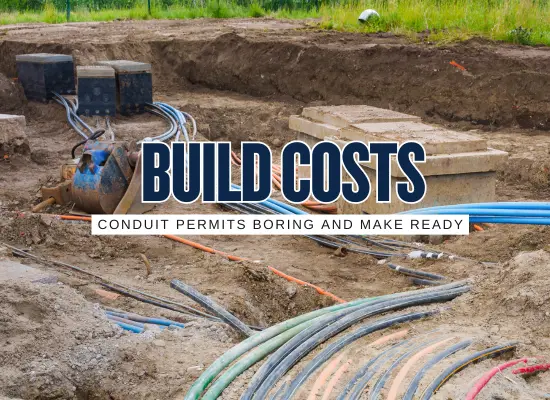
A lot of “fiber is expensive” stories are really “construction is uncertain.” The monthly circuit price is usually the easy part. The hard part is the build: getting rights, opening ground (or poles), navigating make ready work, restoring surfaces, and managing the unknowns that pop up between the first survey and the final light-up.
The cost stack in one sentence
Fiber construction cost is usually less about the glass and more about access, labor, method (aerial vs underground),
surface restoration, pole readiness, and time risk.
Plain-language glossary (so quotes are comparable)
- Conduit: protective duct that fiber is pulled through, often placed in trench or bore.
- Direct-buried: cable placed in the ground without conduit. Often lower upfront cost, less flexibility later.
- Make ready: work to prepare utility poles for new attachments, including rearranging existing attachments and sometimes pole replacements.
- Directional boring (HDD): trenchless method that drills a guided path underground and pulls conduit through the bore.
- Handholes / vaults: access points used for pulling, splicing, and maintenance.
- Right of way (ROW): permission to build in public streets, easements, or controlled corridors.
The major construction cost buckets
Think of a fiber build like a stack of layers. Some layers are predictable. Others swing wildly based on location,
jurisdiction, and what you discover in the field.
1️⃣ Route survey, engineering, and design
This is the upfront work that turns “we want fiber at this address” into a constructible plan: route selection,
utility conflict checks, pole line analysis (for aerial), and bill of materials.
Cost drivers: distance, number of crossings, complexity of as-builts, and how many revisions are needed after field discoveries.
Money leak to avoid: greenlighting a project off a desktop map only, then paying for redesign once the route is walked.
2️⃣ Permits, ROW approvals, traffic control, and inspections
Permitting is not just a fee. It is also time, conditions, and constraints: lane closures, restricted work hours,
inspection scheduling, restoration standards, and documentation.
Cost drivers: municipality requirements, number of separate jurisdictions crossed, and whether work touches state highways or rail corridors.
Money leak to avoid: underestimating the “calendar cost.” If an install is delayed 60 to 120 days, you may pay for temporary connectivity or lose revenue opportunities.
3️⃣ Underground construction methods (trench, plow, HDD)
Underground is usually the biggest variable because the method changes the equipment, crew size, surface restoration,
and risk of hitting unknown utilities.
Method cheat sheet
- Open trench: common in soft shoulders and green space; costly restoration in paved areas.
- Plow: fast in suitable soils and corridors; not always feasible near dense utility congestion.
- HDD: trenchless drilling that avoids open cuts across roads and sensitive areas; pricing depends on soil, depth, length, and number of bores.
Money leak to avoid: choosing a method based on a generic “cost per foot” without pricing restoration, traffic control, and the number of bores and pits required.
4️⃣ Conduit, innerduct, and access structures
Conduit costs are usually not the scary part. The scary part is the labor to place it and the civil work around it:
depth requirements, duct banks, concrete encasement in some jurisdictions, and placing handholes or vaults.
Cost drivers: conduit size and count, duct bank requirements, spacing of handholes, and whether the route needs concrete or special backfill.
Practical tradeoff: conduit can cost more upfront but make future upgrades faster and cheaper because you can pull new fiber without re-excavating.
5️⃣ Aerial construction and make ready
Aerial builds look cheap until you hit a pole line that is full, out of clearance, or needs structural upgrades.
Make ready work is the process of preparing poles for the new attachment.
Make ready may include: rearranging existing comm attachments, transferring lines to new poles, replacing poles, guying, and clearance adjustments.
Money leak to avoid: assuming the new attachment is “just lashed on.” In many areas, make ready is a large percentage of total aerial project cost.
6️⃣ Splicing, testing, and turn-up
After the route is built, crews pull cable, splice, label, and test using tools like OTDR.
This phase is usually predictable, but costs climb when routes have more access points, more fibers,
and more complex handoffs.
Money leak to avoid: forgetting to price the inside portion of the job, including demarc extension, building entrance protection, and rack space.
7️⃣ Restoration and “put it back like you found it”
Restoration is where underground projects can get expensive fast: asphalt, concrete, sidewalks, landscaping,
irrigation, and private property repairs.
Cost drivers: surface type, jurisdiction restoration standards, and whether cuts are allowed or full-lane restoration is required.
8️⃣ Contingency for unknowns
Unknown utilities, rock, groundwater, permit revisions, pole replacements, and schedule delays are normal in fiber builds.
A realistic contingency is often the difference between a project that finishes and a project that stalls mid-way.
Money leak to avoid: setting contingency to zero to “win” internally, then paying for change orders with no leverage.
Conduit vs direct-bury: the decision that reshapes long-term costs
Make ready, explained in a way finance teams understand
Make ready is not “miscellaneous.” It is a real scope of work that can include multiple parties, staged scheduling,
and engineering constraints. It can also introduce calendar risk that is just as painful as the dollar cost.
What pushes make ready costs up
- Pole line is congested and needs rearrangement across many poles
- Clearance issues require moving attachments and sometimes replacing poles
- Work touches power space or triggers outage-sensitive changes
- Multiple attachers and staged scheduling create delays
A budgeting reality that shows up in national surveys
Industry cost reporting has found make ready can be a meaningful share of total project costs, alongside engineering and permitting.
This is why “aerial is always cheaper” is not a safe assumption.
The quote line-items that hide the real bill
Construction cost estimator (simple, but useful in meetings)
This estimator is designed to force clarity around scope and risk. It is not a bid tool. It helps you avoid the common mistake of comparing
two quotes that do not include the same civil work, restoration, and make ready assumptions.
Inputs
Results
Base civil
$0
Permits and traffic control
$0
Make ready allowance
$0
Estimated total (with contingency)
$0
If your vendor quote is far below this model, ask what is excluded. If it is far above, ask which risk items they are pricing in.
Field-proven ways teams reduce construction surprises
The goal is fewer change orders, not a perfect estimate
Most budget pain comes from scope uncertainty. The best teams focus on decisions and documentation that remove ambiguity early.
1️⃣ Ask for the route assumptions in writing
- Number of road crossings and bores
- Surface types and restoration standards assumed
- Depth requirements and duct bank requirements, if any
- Building entrance scope included to the handoff point
2️⃣ Treat make ready like its own project schedule
Ask for the pole count, the expected split between simple and complex work, and the expected coordination steps.
Make ready can add meaningful time even when the cable itself is easy to lash.
3️⃣ Separate “fees” from “conditions” in permitting
A permit cost might be small, but permit conditions can force expensive traffic control, restricted work windows,
or higher-grade restoration.
4️⃣ Use a realistic contingency and define what it covers
Define contingency triggers up front: rock, unknown utilities, pole replacements, permit changes, and restoration upgrades.
Then require documentation before contingency is consumed.
5️⃣ Compare quotes using total delivered outcome
Two quotes can both say “fiber installed,” but one includes full restoration and a clean building entrance,
while the other expects you to pay for those later.
Fiber construction costs are easiest to manage when you break the build into clear buckets, force every proposal to state its assumptions, and treat permitting and make ready as schedule risks as much as line items. With that approach, the project is less likely to stall on surprise conditions that were always possible but never priced or documented.

